
Tag: chronic illness

When the board flips: Paddle boarding through choppy waters

🚨 TL;DR: The “Paddle Boarder’s Guide to Surviving the Medical System”

  • The Problem: For neurodivergent and chronically ill people, a change in medical plans (like a surgery delay) isn’t just an “inconvenience.” It is an enormous, destabilizing wave that threatens to knock us completely into the water.
  • The Metaphor: Most people navigate medical uncertainty on a stable cruise ship. They feel the waves but stay dry. We are on a stand-up paddle board. We require constant, exhaustive internal effort to balance on perfectly calm water. When the system changes, a “ripple” to the cruise ship becomes a catastrophic “tsunami” for us.
  • The Fatigue: We are exhausted not because we are “weak,” but because we are spending all our energy on a silent, Invisible Brace. Every admin call, sensory input, and physical pain is a wave hitting our wobbly board.
  • The “Flip”: When we have a meltdown, shutdown, or cancel plans, the “board has flipped.” This isn’t a failure; it’s a necessary, protective reset. We need to “sink” for a minute to stop the adrenaline of trying not to fall.
  • How to Help: Don’t tell us to “be flexible.” Help us stabilize. Be the solid object we can hold onto. Take over the phone calls and give us the grace to be “underwater” until the sea calms down.

How many of us have heard these words, “Be more flexible”? I didn’t realize that meant my surgery date would be doing yoga while I’m just trying to stay upright. Between the rogue waves of kidney stones and the sinking weight of low ferritin, my medical calendar has become a series of “maybe next weeks” for my lumbar fusion.

To most people, a schedule shift is an inconvenience—a slight tilt on the deck of a cruise ship. But for the neurodivergent and chronically ill, stability isn’t a given; it’s a manually operated system. We aren’t on the cruise ship. We are on a stand-up paddle board in the middle of a high-traffic wake. Each appointment that changes often means changing another appointment, changing a leave request, and navigating yet another unknown.

When the world tells us to “go with the flow,” they don’t see the Invisible Brace. They don’t see the constant, microscopic mental and physical adjustments we make just to keep our heads above the spray. In a medical system that moves like a speedboat, being “flexible” isn’t a personality trait—it’s an expensive, exhausting executive function tax that may eventually lead to our board flipping.

And sometimes, flipping the board is the only way to finally find some peace.

The First Wave

It started with a constant wave pushing my side. A kidney stone—the first rogue wave in a storm I didn’t see coming. Then came the low ferritin, the overwhelming fatigue, and the sudden, sickening realization that my carefully constructed medical plan was no longer a plan; it was a loose suggestion.

In the midst of this chaos, I kept receiving I felt like I just needed to be remain flexible.

But that is a lot to manage: Flexibility is a great trait for a gymnast, but it’s a terrifying requirement for a medical plan. Here is the reality of my recent experience:

The Paddle Board vs. The Cruise Ship

To understand why “going with the flow” is so utterly exhausting for neurodivergent and chronically ill people, you have to understand the difference in our vessels.

Most people experience medical delays or schedule shifts like they are on a massive cruise ship. The floor might tilt, the waves might get choppy, and it’s certainly annoying, but the hull is thick enough to absorb the impact. They stay dry. They stay standing.
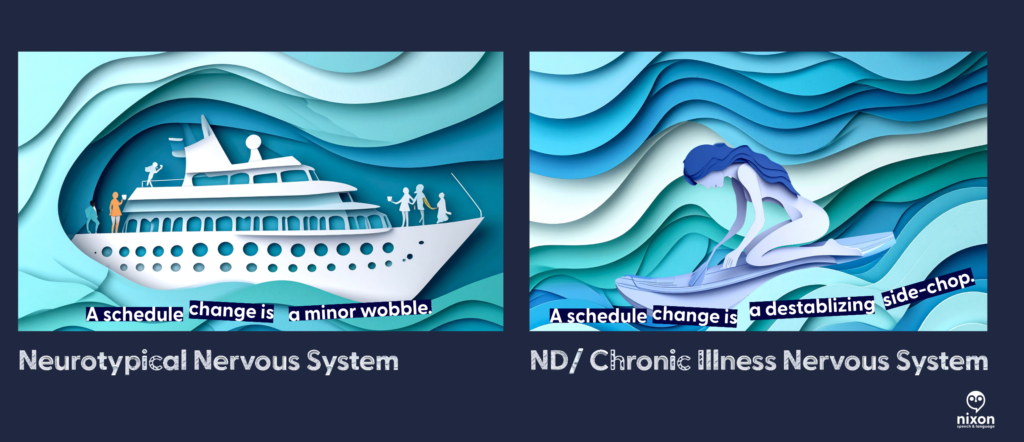
Neurotypical nervous system is like a cruise ship with some waves, it might be choppy but you can still drink your coffee.  

The neurodivergent/chronic illness nervous system it feels like you're on a paddle board and each wave might knock you down. Each wave adds to the overload you might be experiencing.

But when you are neurodivergent—craving predictability to manage sensory and cognitive loads—or living with chronic illness, you aren’t on a cruise ship. You are on a stand-up paddle board.

Even when the water is perfectly flat, we are already expending significant executive function and physical energy just to maintain balance. Every sensory input, every social interaction, and every administrative task requires a micro-adjustment of our internal stabilization systems.

When the medical boat (the scheduling office, the specialist, the test results) suddenly changes course, it creates a massive wake. For the cruise ship, it’s just more water. For the paddle boarder, it is a catastrophic side-chop that we were not braced for. Telling ourselves to “just stand up” when we have been knocked horizontal by the wake is a misunderstanding of physics.

The Invisible Brace: Taking on Water

If it’s not the main wake from the medical boat, it’s the debris. Being neurodivergent in a medical shift (or even change in what to do next) feels like you are paddling through a constant, exhausting stream of waves you cannot anticipate.

While we are trying to keep our balance, the environment is constantly throwing more waves at us, demanding more “flexibility”:

  • The Rogue Wave (The Admin Avalanche): Having to make immediate phone calls to rearrange transportation, update employers, or coordinate with multiple specialists, all while processing bad news.
  • The Side-Chop (Sensory & Cognitive Overload): Navigating an insurance company’s phone menu or reading complex medical instructions while in physical pain and brain fog.
  • The Undertow (Sensory Dread): Mentally bracing for the specific sensory inputs of an impending procedure, only to have that dread extended indefinitely when the date moves.

This is Tether Fatigue. We are exhausted not because we are “difficult,” but because we have been in a permanent, tense, Invisible Brace for weeks, absorbing the kinetic energy of every ripple. Our energy reserves are fully bankrupted by the sheer volume of waves we’ve had to process just to avoid falling in.

Trying to stand on the paddle board with all the administrative hurdles flying around you.

The Grace of the Capsized Board

There comes a point where the balance is lost. The board flips. The paddle boarder goes under. To an observer, this looks like a crisis, a meltdown, or “giving up.”

But here is the secret that the neurotypical world needs to understand: Sometimes, we need to let the board flip.

When we hit the water, the Invisible Brace is finally over. We stop fighting the waves. We stop trying to anticipate the next administrative side-chop. For a moment, there is just the quiet, cold weight of the water.

We aren’t failing to cope; we are allowing the system to reboot because the cost of staying upright on a wobbly board hit by a tsunami has fully bankrupted our energy reserves. We need that “sink time” to stop the adrenaline and let our nervous systems reset before we can even think about climbing back onto the board.

How to Be an Anchor
If someone you love is neurodivergent or chronically ill and their “ship” has just flipped, don’t stand on the shore and yell at them to swim harder. Help them stabilize the water.

  1. Reduce the “Administrative Friction”: When the plan changes, the “to-do” list explodes, requiring executive function we don’t have.
    • Don’t say: “Let me know if you need anything.”
    • Do say: “I am standing by a phone. Give me your permission, and I will handle the rescheduling calls today so you don’t have to explain your situation five more times.”
  2. Validate the Physics, Not the Feeling: Don’t gaslight us with positivity. Acknowledge the environment.
    • Don’t say: “Just keep rowing! Be resilient!”
    • Do say: “The water is incredibly choppy right now. It makes total sense that you fell. I’m right here when you’re ready to try again.”
  3. Grant the Grace to Sink: Let us stay underwater for a minute. We need that silence to recalibrate before we have the strength to climb back onto the wobbly board.

Examples of Stabilization in Action

Example A: Dear Medical Provider (The View from the Paddle Board)

“When you tell me a surgery is delayed or a result requires a pivot, you might see it as a minor scheduling shift. For my neurodivergent brain and my chronically ill body, it is a tsunami hitting a stationary paddle board. Please help me stay above water:

  • Reduce the Administrative Friction: Don’t make me the middleman between specialists. Coordinate the update with my other providers so I don’t have to spend my limited energy repeating my trauma five times.
  • Give Me a Fixed Point: Tell me exactly what the next step is. Ambiguity is a wave I cannot balance on.

Example B: Dear Friend (When My Board Flips)

“Right now, the floor is shaking. I am exhausted from trying to ‘stay upright’ on a board that feels every single ripple. When you see me overwhelmed, please know that I’m not being difficult—I’m bankrupt from navigating a constant stream of administrative and sensory cross-currents. Here is how to be my anchor:

  • Don’t Ask, Just Do: Telling me ‘I’m bringing over safe food at 6:00 PM’ is infinitely more helpful than ‘Let me know what you need.’
  • Let Me Sink: If I cancel, don’t take it personally. My board has flipped, and I promise I’ll climb back on when the sea calms down.”

Flexibility isn’t a personality trait; it’s an expensive resource. For the neurodivergent and chronically ill, “going with the flow” often means fighting the current just to avoid drowning. Sometimes, the best way to help us is to just let us float until the sea is still again.


Note about the art:

To capture the “layered” nature of neurodivergent life, I used a collaborative AI process to create the visuals for this post. I worked with Adobe Firefly to generate the base “paper-cut” style and used Gemini as an “Art Director” to refine the metaphors—ensuring the “administrative debris” and the “underwater reset” felt as visceral as the words themselves.

Read more: When the board flips: Paddle boarding through choppy waters

What’s in a name? Dealing with unknowns

Stephanie M. Nixon, Ph.D., CCC-SLP
January 29, 2025


The power of a name, label, or diagnosis – even the name of a symptom

What’s in a name? A label? A diagnosis? Does knowing a diagnosis grant us power? Does it provide the knowledge we desire when confronting a situation (not just learning disability or health-related)?

When I wrote about this years ago in my undergraduate thesis about Egyptian religion, I noted the similarity between naming gods and goddesses who “controlled” various aspects of life (love, weather, sun, rain, etc.) and naming hurricanes. I know this is over simplified in some ways, but there is a parallel.


“Sometimes naming a thing — giving it a name or discovering its name — helps one begin to understand it. Knowing the name of a thing and knowing what that thing is for gives me even more of a handle on it.” — Octavia E. Butler, Parable of the Sower


Thinking about what Octavia E. Butler said above, it makes sense (at least to me). It helps to just understand sometimes. And other times, it might bring a “fix”. Granted a often there isn’t a “fix” or “cure” for learning disabilities or chronic illnesses or even natural disasters. i.e., It’s not always just here, take this medication for 10 days and you’re all better. (I wish it was that easy…)

  • For learning disabilities like dyslexia, we might be able to provide supports like special reading programs, audiobooks, etc. But we cannot “cure” dyslexia. Here is some information from Guinevere Eden, Ph.D. via ReadingRockets.org.
  • For ADHD and autism, there are no cures but there are treatments and there is understanding.
  • For chronic illnesses like my diagnosis of Hashimoto Thyroiditis, often there is no cure. You might need to take a medication daily depending on your doctor’s advice. Some chronic illnesses are even progressive. Some are merely described via symptoms, but we cannot “cure” it.
  • For natural disasters, we cannot stop the hurricane from hitting an area, but we can prepare for it. And we can provide disaster relief afterwards to help an area recover

What have I seen, personally and professionally?

As a practitioner, I sometimes patients/caregivers wanted a diagnosis and others wanted the descriptor and support. For adult and pediatric patients, a label can help with insurance coverage. For pediatric patients, a label (i.e., a diagnosis – even working diagnosis, e.g., autism, dyslexia, etc.) can help with access to special education services and accommodations and insurance coverage for services.

As a patient, adding the diagnosis of autism to my long-time diagnosis of ADHD helped me understand those feelings of overwhelm from too much noise, too many “things” coming at me, and much more. Has it “fixed” the situation? No. But it gives me grace in those moments or even afterwards when I can recognize the link to “autism”. (I recognize this won’t apply to everyone. Some people find hearing the actual diagnosis scary.)

What’s in a name?

When it comes to chronic illnesses (even acute), speech and language disorders, learning disabilities, autism, ADHD, and more, we as patients (and even practitioners) often want to know the diagnosis/name. We want to understand what we’re dealing with. But why?

  • Empowerment, knowing how to prepare, find options, and find ways to cope (social groups, etc.)
  • Validation, knowing what we feel/see is happening, someone else sees it
  • Understanding, understanding of ourselves and what we need and for parents of a child, understanding of a child’s needs
  • Forgiveness of ourselves (our children and loved ones where applicable), knowing a “diagnosis” can help a person recognize how the diagnosis affected a situation and forgive themselves or another for this. (I’m not saying a diagnosis is an excuse! I’m saying, it can give that allowance to make that mistake.)
  • Access, having a diagnosis or adequate symptom description can give access to accommodations, insurance coverage, and research studies that are otherwise unavailable. (e.g., For pediatric speech-language therapy, many private insurance plans have exclusions saying that services are only covered in cases of accident, injury, stroke, or autism spectrum disorder.)

What do many patients want?

As a patient, I want to be heard. I want to be validated. I am living this life, not the practitioner. I want that practitioner to treat me like I treated my patients, which is to listen, genuinely listen. Don’t discount what I’m telling you because you aren’t seeing it in this moment at this time.

When I saw patients, I tried to remember, treat them like I wanted to be treated. Yes, they may want the why, the cure, the fix, but I did my best to explain what I saw and next steps. And hear their responses and consider them in light of what I saw in that 2 hours in my office.

And of course there are times we may find nothing definite, but we can validate their experience. We can listen. We can recognize when there is something off that just may not be recognized by available tests.

And with all that in mind the best thing you can do is “find a doctor that cares”. (See this amazing video from Dr. Erin Nance.)

Sometimes we don’t know the “exact” diagnosis

There are many times that there isn’t an exact diagnosis. We can describe the symptoms and those might even have “diagnosis codes” in ICD-10, but we may never know the overarching “cause” for those symptoms or if there is one. BUT, even describing the symptoms and assigning ICD-10 codes provide a “name”.

Like many of my families and patients I have had over the years, I have navigated the waters of the unknown with my health and learning. I know how scary those waters can be. I know there isn’t always an answer, but my objective is to benefit others with my knowledge and experience. Even if it’s just how to navigate healthcare systems or health insurance or a diagnosis/symptom.

More recently, I decided to record some of my symptoms and post them to YouTube to share the journey with others. My hope is that professors, practitioners, and patients can benefit from these in some way.

Would I like to know a cause? A name? A diagnosis? Who wouldn’t? BUT – even if I can’t learn that information – if I can benefit others, then in my opinion I won.

Thoughts for providers

Providers, if you are frustrated by patients seeming “hung up” on getting that “label”, it’s for the reasons I said above. What can you do?

  • Respect the request – and try to understand
  • Sit in their shoes a minute
  • Ask the patient/family why they seem to “want” the diagnosis
  • Consider whether they experience something you may not see in your office
  • Use your active listening skills
  • Consider reviewing the data and scheduling a follow-up
  • Avoid assuming you know more about that patient than the patient/family (you only see them for that short period in your office)
  • Empower them to help you see what they see
  • Ask if there is an insurance reason they need a diagnosis
  • Consider whether the person could benefit at minimum from an acting diagnosis (if appropriate) to give them access to care that would otherwise be denied
  • Ask them how what they report is different than previous function (if appropriate)
  • Ask how it is affecting them in daily life

Tangent. Consider a patient’s background during the appointment

If that patient is an allied health professional trained in the area they are coming to you about, please pause and consider that this patient may be using every tool they know to minimize the effect of their concern in your office. Listen. Think about the tools they might have – objective tools (like a measure of grip strength for OTs) – that you don’t.

An example from many years ago

Over 10 months from 2010 and 2011, I went through over 20 rounds of antibiotics for respiratory infections before seeking a pulmonary doctor. Finally, I went in. My voice was hoarse from all the coughing. I told the doctor (who will remain nameless) that I was going to lose my voice. I asked for someway to help the cough so I wouldn’t lose my voice. (Try being an SLP with no voice.)

The doctor told me I wouldn’t lose my voice. I reminded her of my training. I reminded her of my specialty. I was dismissed. I was in tears trying to explain myself to her.

Fast-forward. The sputum culture returned. It was Methicillin Sensitive Staphylococcus Aureus. I was given an antibiotic. But due to coughing, I lost my voice 24 hours later. I did not regain enough voice to return to work for at least 3 weeks. (Even when I returned, I barely had enough voice to talk through the day.)

I saw an ENT who specialized in voice, who said I had an ulceration on my vocal folds from coughing.

To patients and practitioners

I understand the frustration from both sides. I’ve been there. I’m there right now. I know how scary the unknown is, but let’s work together. Let’s listen.

Practitioners, involve patients who want to understand when reviewing their case. Don’t hesitate to say “I don’t know” or “I need to go look that up”. Just be sure to get back to the patient later.

Patients/families, I know the information is sometimes overwhelming. Don’t hesitate to pause the practitioner, repeat what they said, and as if you understood. As for a list of action items. And tell the practitioner if you have any barriers to accomplishing those items (even time to make those phone calls). Find out how to contact your practitioner. You deserve someone who will listen and advocate for you.

So…again, what’s in a name, a label, a diagnosis? It can be more than a provider might know from access to understanding. Validating a symptom observed goes a long way, especially if that has an ICD-10 code – even if there is not treatment available. And that ICD-10 code is something researchers might look up in the system in the future and look at associated health conditions which could lead to better understanding and treatments.

Yes, that might be a long way off, but again, for someone like me who just wants to help others, I don’t care if it’s 100 years off. If my data helps practitioners and patients learn about health conditions, then I will view it as a win.

Disclaimer. This article is based on personal and professional experience as well as research on counseling patients. This information is not intended as legal advice or healthcare advice. Please see a provider about any healthcare needs. I acknowledge that some people need different approaches than others when receiving information, so again, providers use your informed clinical training and judgment.

Read more: What’s in a name? Dealing with unknowns

Access and advocacy active listening andoid childhood apraxia of speech chronic illness claims processing communication log deductible Department of Education Discord doge Dyslexia dyslexia emoji dyslexia symbol education emoji errors processing claims google health insurance health insurance appeals health insurance benefits health insurance mistakes health unknowns Independent Funding innovation Institute of Education Sciences iOS18 iPhone Kanban Task Tracker learning disabilities managing your health max out of pocket National Institutes of Health neurodivergence NIH Organizer petition pharmacy benefit managers Planner pqbd.org research research design Research Funding speech-language pathology Systematic Research


Leave a Reply

Your email address will not be published. Required fields are marked *

Read more: What’s in a name? Dealing with unknowns